
In the first article in this series about Salem's maritime trade with Asia, I examined issues with Dr. R. Michael Feener and Vijay Joyce's use of sources in their 'Minority Report'. This article examines some additional historical context missing from this highly misleading report.
Feener and Joyce maintain that the historic evidence unequivocally proves that Salem merchants and seafarers rejected the violent imperialism of 1800s. They contend that Salem's aldermen in 1839 had opposed the brutal bombardments of Aceh conducted by the U.S. Navy and Marines in 1832 and 1838. By selecting a city seal that had an Acehnese man standing below a dove with an olive branch in its beak, George Peabody and his fellow aldermen were sending a message of "reconciliation and goodwill" to the Acehnese people.
Yet the 'Minority Report' omits significant historical contexts that shed insight into design choices made by Salem's aldermen, which I highlight below. I also examine the question that conspicuously absent from the 'Minority Report': if Salem's merchants and seafarers had such a friendly relationship with Acehnese locals, why were their ships attacked?
A Prominent Scholar Ignored by Feener and Joyce
In her presentation to the City Seal Task Force Dr. Erika Lee agreed with Feener and Joyce that Salem's city seal was designed to project an image of peaceful and prosperous trade relations with Sumatra. But she doesn't believe that the motivations of aldermen who approved the seal were as pure as they contend.
Here is the summary of her presentation that appears in the City Seal Task Force Report:
The seal’s ship, dove, and “Asian” figure sought to project an image of peace and global friendship that recast the City’s identity away from the site of the witch trials. But historians contend that the Seal design served as an act of civic self-mythology, designed to obscure economic decline and moral unease. The Seal’s sole focus on peace and friendship also hid a troubling history of exploitation and violence....While Professor Feener emphasizes moments of mutual respect and cultural curiosity, Lee’s presentation reminds us that civility within unjust systems cannot erase hierarchy. To her, the Seal’s beauty conceals an uncomfortable legacy of racial capitalism and selective memory—a history that shaped not only Salem’s wealth but also America’s racial inequality and emerging imperial identity.
Lee is scholar of U.S. history at Harvard University and the author of several acclaimed books on Asian American history and culture. With the exception of a nitpicky and longwinded criticism of a single comment Lee had made about the 'umbrella' in Salem's seal, Feener and Joyce have largely ignored the substance of Lee's presentation. Below I outline few important points from her presentation that I've expanded upon with my own research.
Economic Factors That Influenced The Seal's Design
To understand the seal's design, you must first recognize that Salem's maritime fortunes had been in sharp decline at the time it was created. By the time Salem officially became a city on March 23, 1836, its economy had weathered two foreign trade embargoes that disrupted its maritime trade with Sumatra.
The first embargo had been signed into law in 1807 by President Thomas Jefferson in response British and French interference with American trade during the Napoleonic Wars. Not surprisingly, this embargo had a deviating impact on Salem. According to George Schwartz in Collecting the Globe: The Salem East India Marine Society Museum, nearly all of Salem's ships and crews were idle due to the embargo, leaving one-fifth of the population was unemployed.
In 1809, this embargo was lifted for all countries except Britain and France. But this respite was short-lived. The War of 1812 led to another embargo on all foreign trade, which significantly impacted Salem's prominence as seaport. "By the end of the war, Salem merchants had started to move their businesses to Boston, New York and other larger harbors," writes Schwartz. "The city never attained its pre-embargo economic prestige, although it remained a busy port until the 1840s." (page 47)
Another noteworthy economic development is that construction on the Eastern Railroad that connected East Boston with Salem was completed in 1838, the year before Salem's seal was adopted. This expanding network of railroads helped Boston eclipse Salem's prominence as a trading port. The final bulk shipment of pepper from Sumatra to arrive in Salem was in 1846, seven years after the seal's adoption.
Salem's Merchants Declining Influence
In the midst of this period of decline, Salem's merchants were no doubt nostalgic for their golden age. George Peabody and other pepper trade merchants were fully aware of their diminishing fortunates and influence. The seal was an opportunity to cement their legacy. In her presentation, Lee asserted that the seal was intended to remind current and future Salem residents that the local pepper trade merchants had brought the city its wealth and prominence.
For this article, I reached out to Dr. Anthony Guidone who has extensively researched Salem's maritime history for his doctoral thesis. He agreed with Lee's assessment about the motivations of Salem's aldermen in 1839. Via email he wrote:
The seal was designed to celebrate merchant families who made Salem prosperous some twenty-five to forty years before 1838. It was created amidst a decade in which the status, importance, and centrality of maritime commerce had sharply declined. I think it was a reminder or reassertion of who was important in Salem. The seal's design...reflected a vision of Salem's past, as the city was no longer a bustling commercial port by the time of the seal's creation.
Violence Was Bad for Business
But what about that dove positioned above the head of an Acehnese merchant? Isn‘t that proof that Salem's merchants desired a peaceful relationship with Acehnese locals?
It's important to recognize that Salem's merchants were financially motivated to extend this olive branch to the people of Aceh. The Acehnese raids on American ships and the punishing U.S. bombardments of Aceh in 1832 and 1838 led to volatile trading conditions in the midst of a period of economic decline. Lee believes that the seal's design was intended to allay any reservations Acehnese merchants had about doing business Salem seafarers.
Even Feener conceded the seal's design was financially motivated during remarks he had made after Lee's presentation to the City Seal Task Force:
"The dove of peace...in that context of the late 1830s, especially in the wake of these two much criticized attacks on Kuala Batee, this was bad for business for Salem merchants. The trade was already slowing down, this was making it much harder to do it anymore....We could see the seal as local Salem merchants whose ongoing relationships with Sumatra in particular were being endangered by this pushing back and really calling for a restorative peace."
It's important to note that there is no evidence that Salem's merchants were personally outraged by the U.S. massacres of Acehnese people in 1832 and 1838. Lee said to Feener that she had hoped to find evidence that the seal's designer, George Peabody, had been offended by the U.S.'s military aggression in Aceh, but she could find none.
American Sentiment After the Bombardments of Aceh
The 'Minority Report' leads readers to believe that the U.S.'s decimation of Kuala Batee (‘Qualla Battoo’) was uniformly condemned by the public in its aftermath. During her presentation, though, Lee dispelled this notion. "When news of the attack first made it into American newspapers some five months later, Captain Downes actions did cause some stir in Washington, D.C." she said. "But public opinion, including in Salem, seemed to mostly approve."
She shared an excerpt of an article that was originally published in the New York Evening Post and republished in the Salem Gazette shortly after the bombardment of Kuala Batee (‘Qualla Battoo’) in 1832:
"The tribe to which the piratical wretches belonged, who murdered the crew of the Friendship have been taught that their victims were of a nation that can stretch its arm over continents and seas to protect its citizens, and to avenge their blood."
She also shared a broadside printed in 1832 that glorified U.S. military forces and justified the attacks as a defense of national honor and maligned the Acehnese people as savages and pirates.
A Closer Look at the 'Minority Report's 'Proof'
The 'Minority Report' cites research by Dr. Farish Noor to bolster claims that the American public and media had resoundingly condemned U.S. military aggression in Aceh: Page 14 of the report reads:
The need to recognize more nuance in our appreciation of this history has also been recommended by Farish Noor in his work on the 19th-century ‘media fall-out’ of press coverage of the American attack on Kuala Batee. Noor sees the public debate around the event as “…a reminder for those who may mistakenly believe that 19th century Western colonial adventurism and expansionism was without its critics back home…"
Yet a closer examination of Noor's research reveals that he had found public opinion about the bombardments was actually divided, which is the 'public debate' to which he was referring in his quote. His papers on this topic cite examples of both condemnations and praise of U.S. military aggression in Aceh in U.S. media. (See, for example, this working paper by Noor that referenced as a footnote in the 'Minority Report'.)
In his book, The Long Shadow of the 19th Century: Critical Essays on Colonial Orientalism in Southeast Asia, Noor also contends that the public outrage over U.S. violence in Aceh was actually not grounded in a concern for the Acehnese people. American anger about the first bombardment had focused mainly on the murder of Acehnese women, which reflects cultural attitudes of the time. Noor writes:
Here was a case of selective outrage played out in the public arena for blatantly political ends and means, and in the course of this media-led campaign the trope of the helpless Asian woman was instrumentalised to serve domestic political needs. But in the course of doing so, the actual history of Southeast Asian women was erased/marginalised, and what we are left with is a static and two-dimensional trope that was employed and weaponised like so many of the other Orientalist tropes and clichés of the 19th century. (page 246)
He adds:
Finally, it has to be noted that throughout this debate in the United States, the voices and opinions of the Southeast Asian Other were never consulted or even deemed relevant to the discussion. American commentators may have been appalled by the fact that white American males had killed Asian women in distant lands, but their sense of outrage was rooted in their own understandings of what constituted male identity and idealised masculine behaviour. (page 246)
Why did the Acehnese Raid Salem's Friendship?
In their 'Minority Report', Feener and Joyce have shown a remarkable lack of curiosity about why Acehnese locals had attacked Salem's Friendship in 1831 (and then another American ship seven years later). Both of these raids had instigated the two U.S. massacres in Aceh. If the relationship between Salem sea captains and Acehnese locals was as harmonious as Feener and Joyce contend, why did these raids happen?
Historical evidence shows that by 1830 Acehnese locals had grown increasingly resentful of Salem's sea captains. In his book A Great and Rising Nation: Naval Exploration and Global Empire in the Early US Republic Michael A. Verney writes:
“The residents of Kuala Batu, Sumatra, were feeling increasingly desperate. The price of their pepper exports—the economic lifeblood of their community—had dropped precipitously in early 1830. The townsfolk fell on hard times. Many blamed the downturn on the greed of the Salem shipmasters who had dominated the global pepper trade. Since distrust and deceit had long characterized relations between US and Sumatran merchants, it was an easy conclusion to reach. Growing poverty and a sense of economic dependence nourished a quiet rage.” (page 43)
This distrust stemmed partly from the exploitive business practices of British and American captains (including those from Salem). In an article published by Essex Institute Historical Collections in 1956, James W. Gould investigated what possibly motivated the Acehnese capture of the Friendship in 1831. Based on his research, he speculated that this raid occurred because the Acehnese were enraged by Americans repeatedly cheating them.
Apparently it had been a common practice for American captains to use false counter weights to avoid paying a fair price for Acehnese pepper crops. Gould notes that Americans felt justified in cheating because they suspected Acehnese weighed down their crops with sand, stones and sticks to get a higher price. But he also cites a passage from G. F. Davidson's book Trade and Travels in the Far East published in 1846:
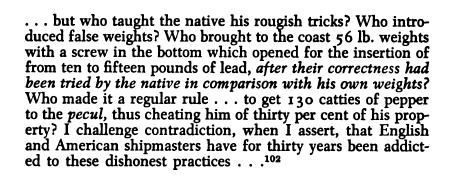
It seems that relations between Salem's sea captains and Acehnese merchants were not always as peaceful and respectful as Feener and Joyce maintain.
Gould's article is another example of the highly selective quoting of sources in the 'Minority Report'. Feener and Joyce cite Gould's article as a footnote to this sentence:
Referencing a comment by Sir T.S. Raffles (who had been posted to the British fort on Sumatra’s west coast at Bengkulu), James Gould notes that Salem’s Sumatra trade had “proved that free enterprise could produce far greater results than slave labor.”
Yet despite having read this same article by Gould, they neglected to note any evidence about the dishonest business practices of Salem's captains in their 'Minority Report'.
A Narrow Definition of Colonialism
In their 'Minority Report', Feener and Joyce insist that relations between Salem seafarers and Acehnese merchants were so respectful that they could not be "simplistically characterized as 'colonial encounters.'" As further evidence that the U.S. had never become a colonial power in Aceh, they note:
No evidence exists of any attempts on the part of the Americans to establish settlements in Sumatra, nor of initiatives to build fortified trading stations, or to use the force of arms to secure favorable trading terms.
The City Seal Task Force received letters from several academics criticizing this narrow definition of colonialism. Dr. K. Ian Shin, Assistant Professor of History and American Culture at the University of Michigan writes the following in his letter:
"While it is true that Salem's merchants and sailors played a formative role in building early U.S. trading networks around the globe, the narrative of peaceful and collaborative exchange between Salem mariners and their Sumatran counterparts is, at best, incomplete. A half century of scholarship since the 1970s has thoroughly documented how the world of American seafarers in the 19th century was steeped in violence, racism, and the aggressive assertion of U.S. commercial and political dominance. These traits cannot and should not be disentangled from the history of Salem's relationship with Sumatra."
The next installment of this series will highlight examples of racist behavior by Salem's seafarers and merchants and anti-Asian sentiment in the U.S. at the time of the seal's creation. In the meantime, I highly recommend watching Lee's presentation to the City Seal Task Force in its entirety because it examines this topic in depth.