
At the heart of the debate regarding Salem's city seal is the question of about how we want to portray ourselves in the present day. Because a seal officially represents a city, it should embody that city's values. Salem was a very different city in 1839. It is reasonable to ask whether a seal designed almost 200 years ago still reflects our identity and values. This question is particularly significant because our AAPI neighbors find the current seal offensive.
Supporters of Salem's current seal have sidestepped this question and instead focus on how present-day Acehnese people feel about it. They firmly believe that the Acehnese people are honored that our seal depicts an Acehnese merchant (as seen through the eyes of white selectmen from 1839). They reached this conclusion based on a small selection of Acehnese people who have provided public feedback to the City Seal Task Force. They ignore the fact that every Acehnese person who came forward had been solicited by a prominent academic whose opinions about the seal had already been well-established.
While proclaiming to care deeply about the views of the Acehnese people, the seal's supporters have ignored or ridiculed members of the local AAPI community who have unequivocally said that the current seal is hurtful.
The Source of This Focus On Acehnese Views
The driving force behind the claim that the Acehnese people love Salem's seal is Dr. R. Michael Feener, a professor at the Center for Southeast Asian Studies at Kyoto University and an Associate Member of the Faculty of History at Oxford University. Though he has not lived in the United States for decades, Feener was born in Salem and has family and friends who still live here. He received his doctorate in Religious Studies at Boston University. His research has primarily focused on Islamic law in 20th Century and present-day in Aceh, Indonesia.
Ahead of the City Council meeting on September 26, 2024 at which the City Seal Task Force would be debated, Feener wrote to Councillors to advocate against changing the seal. In his letter, he included testimonies from three present-day Acehnese people—out of a population of 5.5 million—who did not want to see the seal replaced.
During deliberations about the establishment of the City Seal Task Force, Councillor at Large Conrad Prosniewski was so moved by Feener's letter that he advocated for adding someone from Sumatra to the Task Force. "[Feener's] feeling was that those people who are going to be directly impacted should have a say in this," Prosniewski said. "I happen to agree with him."
That night the City Council approved the establishment of the City Seal Task Force (without a requirement for Acehnese participation) by an 8-3 vote. Feener himself applied to join the task force and was appointed by the Mayor in early 2025.
'Evidence' of Acehnese Support
After the task force released its report that recommended changing the city seal, Feener and fellow task force member Vijay Joyce released their own unofficial version in protest, which they dubbed the 'Minority Report'. The report maintains that changing the seal goes against the will of the Acehnese people. On page 36 they write: "In contemporary Aceh, reaction to the news that Salem was considering changing the city seal has been overwhelmingly against the idea of changing the seal."
Last summer, Feener traveled to Sumatra for a research trip. While in Aceh, he gave several presentations that championed his views that Salem's sea captains had treated Acehnese merchants with fairness and respect. He also met with with the Bupati (or Regent) of the Aceh Barat Daya Regency to promote his views about Salem's seal. Feener also gave podcast interviews about Salem's maritime history while he was in Aceh.
This PR effort should be viewed as just that. It by no means signifies that most Acehnese people care about—let alone support—Salem's current seal.
The 'Minority Report' includes remarks made by Acehnese people during the City Seal Task Force's public listening sessions. Altogether a total of ten Acehnese people participated in these sessions. They had responded to an invitation Feener had posted in a Whats App group for colleagues and former students residing in Aceh. The members of this chat group were undoubtedly well-acquainted with his views about the seal.
It's also worth noting that at least one of the Acehnese respondents works for Feener. Footnote #83 in the 'Minority Report' cites remarks from Maida Irawani in opposition to changing the seal. The report neglects to mention that she is a project manager for the Maritime Asia Heritage Survey that Feener leads.
The Acehnese people who participated in the listening sessions were academics with doctorates in Southeast Asian studies. This group is hardly a random sampling of the general Acehnese population. Furthermore ten people cannot possibly represent a population 5.5 million.
Granted, the Governor of Aceh, Muzakir Manaf, sent a letter to city and state leaders asking that Salem keep its seal. Given that Feener met with with the Bupati (or Regent) of the Aceh Barat Daya Regency to promote his views about the seal, it is reasonable to question what involvement he had in soliciting this letter from Aceh's Governor.
Manaf's letter also does not necessarily reflect the views of the Aceh population as a whole. Do Donald Trump's Truth Social posts addressed to world leaders reflect your views? Freedom House has given Indonesia a Global Freedom Score of 56/100 (partly free) and an Internet Freedom Score of 48/100 (partly free). The institute does not grade Aceh independently, but the province's "interpretation of Sharia (Islamic law) to guide punishments and regulations" is cited as reasons for low marks in Indonesia's rule of law category. Last August, two gay men were publicly flogged after a court found them guilty of having sexual relations.
The Acehnese Have Different Lived Experiences Than Salem's AAPI Residents
Those who claim that Salem's seal isn't racist because it has the support of (some) Acehnese people reveal a profound lack of understanding of how racism works. AAPI residents of Salem have vastly different lived experiences than Acehnese people living in Indonesia.
Only 3.5% of Salem residents are members of the AAPI community according to the U.S. Census Bureau. Our AAPI neighbors live in a country with racist cultural biases and deeply entrenched systemic racism. They are often othered and regularly experience microaggressions in their professional and personal lives. They are routinely exposed to anti-Asian tropes in media and culture. In contrast, Asians living in Asia are in the majority. Their culture centers Asian people with media that is created by Asian people for Asian audiences.
During one of the City Seal Task Force meetings, Rachel TonThat pointed out to Feener that Asian Americans in the United States have different lived experiences than Asians living in Asia. She had recently returned from a trip to Vietnam and shared a story about Vietnamese acquaintances who had experienced racism while visiting Italy. She observed that they had not experienced anti-Asian hate before because they live in Asia. TonThat then added:
"There's been a little bit too much emphasis on how Acehnese people feel about the seal, but we also really want to focus on [AAPI] people who are living in Salem and who are experiencing things in Salem on the ground and that is a very different perspective."
While (some) Acehnese people today might be proud of Salem's seal, their relationship to it is different from that of Salem residents. They have not regularly encountered anti-Asian tropes in their media, art, and advertising. They also are not exposed to the seal in their day-to-day lives. They aren't seeing it on their road signs or on their trash barrels or on their marriage certificates. Their kids haven't been mocked by their peers because they look like the person on the seal. The people of Aceh cannot possibly be as invested in the seal as those who experience its harmful impact daily.
Bastardization of DEI Concepts
To add further insult to the local AAPI community, proponents of the seal routinely regurgitate bastardized Diversity Equity and Inclusion (DEI) concepts to justify their focus on Acehnese opinions of the seal. While giving public testimony at the City Council meeting held on September 26, 2024, Justin Whittier said:
"We've heard in these chambers that if you're not part of the affected community, you have no right to an opinion. Well, the affected community here is the Acehnese community, and you have all heard from members of the Acehnese community. You received that email from Professor Feener. They not only felt that there was nothing racist about it, they supported it. They appreciated it, and they hoped that it wouldn't be changed."
As another example of this perversion of DEI concepts, consider this passage from the section of the City Seal Task Force Report written by Vijay Joyce and Dr. Feener:
![Representation matters. As one Salem resident pointedly noted in her contribution to the public listening session on October 14th, as a lesbian woman she would not be comfortable with an agenda pursued in the name of the LGBTQ+ community that was driven only by gay men representing a purportedly broader coalition of allies, but without any actual lesbian participation through which she could feel adequately represented. Ignoring both the actual history of Salem’s trade with Sumatra, as well as the voices of so many Acehnese people alive today in a discussion about how they are represented flies in the face of our stated commitment to respecting the identity of diverse communities, equitable treatment in the public sphere, and inclusivity of historically marginalized communities [12]. We should not be contributing further to the erasure of a culture that has already faced so many past onslaughts [13]. Appropriating the claim to unilaterally determine the way in which members of another ethnic group are represented in the public sphere – or erasing it entirely against the will of those very people – in the way that some in Salem have attempted to do out of an apparent disregard toward will of the people of Aceh is something that should be anathema to anyone who supports progressive work toward the respectful recognition of diverse perspectives, equitable treatment of all parties engaged in multi-cultural dialogue, and the inclusion of historically marginalized communities.](https://storage.ghost.io/c/cb/6c/cb6c1b07-94b0-4de2-8f03-23345da87b6f/content/images/2026/08/Screenshot-2026-08-15-at-6.08.28---PM.png)
Using this rhetoric to justify ignoring the pain of Salem's AAPI community is next-level gaslighting.
When the People of Aceh Would Need to Be Consulted
If the City of Salem commissioned a public artwork honoring the Acehnese people, then absolutely the Acehnese people would need to heavily consulted on how they are depicted. In that scenario, ideally an Acehnese or Indonesian artist would be hired to create this artwork.
The City of Salem took this exact approach when they commissioned American Indian artist Chris Pappan to create the painting that is prominently exhibited in Salem's City Council Chambers. The city's objective was to create a painting that honored both Salem's Indigenous history and the Massachusett Tribe, whose land we stand on today.
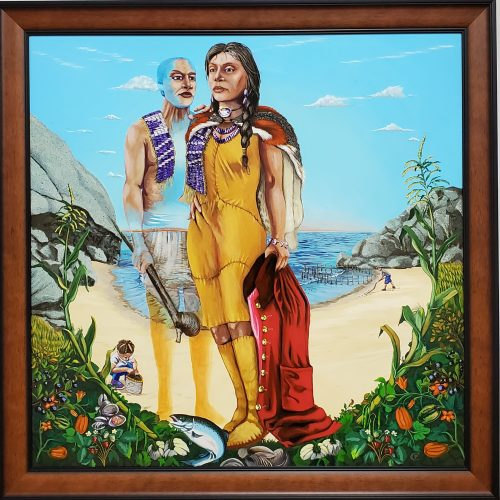
Pappan worked in close consultation with the Massachusett Tribal Council on the painting, which is portrait of Squaw Sachem and Nanepashemet, leaders of Naumkeag village and Pawtucket band of the Massachusett Tribe. To create these portraits, Pappan used photographs of present-day Massachusett Tribal members, along with historical research provided by the tribe. The reason why Squaw Sachem is holding a red coat in the painting is because she requested a jacket from British troops for each treaty she signed with Puritan colonists.
Ironically, this thoughtful approach to creating this painting was entirely lost on Justin Whittier during his public testimony on the night of September 26th, 2025. While dramatically pointing to the painting he said, "[The seal] is not a caricature or logo, it's not branding, or stereotype. It's none of these things. But if it is, that portrait right there is every one of those things."
Changing the Seal Does Not Erase Acehnese Culture
The current debate around the current seal is focused on whether or not to keep it. The City of Salem is not commissioning new artwork that recognizes the city's historic ties with Aceh. Instead, city councillors are deciding whether a seal designed nearly 200 years ago still represents the people of Salem today. This matter does not concern the Acehnese people.
Furthermore, changing our seal would not erase Acehnese culture, as Feener and Joyce allege in their 'Minority Report'. The new seal could incorporate visual elements that honor our historic ties with Aceh, such a pepper branch. In fact, the City Seal Task Force recommended this idea in its report.
Although designing a new seal was outside of the task force's mandate, the report recommended that a new design:
- Avoid the depiction of human figures or witch imagery;
- Highlight inclusive, representative visual elements;
- Reflect Salem’s maritime heritage, diverse community, and enduring ties to Aceh.
It's worth remembering that the Acehnese were not consulted when the seal was created in 1839. The 'Minority Report' has a lengthy analysis about the seal's authentic depiction of the Acehnese man on it. But there is no evidence that Salem's selectmen had actually consulted Acehnese merchants when designing the seal.
If the City Council decides to change the seal, Acehnese and/or Acehnese American artists could be involved in its redesign, which would give them more control over how Aceh is represented on our seal.
A city seal is not a historic artifact that must be preserved. Retired city seals are, though. And there is no reason why our current seal would be "erased from history," especially given Salem's strong ties to the Peabody Essex Museum, which has a prominent collection of historic maritime art.