This guest essay by Benjamin Shallop originally appeared in The Salem News and has been updated for this publication.
In the spring of 1637, the First Muster of the East Regiment occurred on Salem Common. This event is widely understood to be the birth of the National Guard. While we celebrate this milestone every year, it was only recently that we as a community started discussing why the regiment was mustered in the first place. It’s a conversation that is needed and long over due, because the newly formed East Regiment would go on to participate in the first act of genocide carried out by the English colonists in North America.
We need to be honest about that.
It is certainly true that the Pequot War was not the first genocide in North America. By the 17th century, European diseases had decimated as much as 90% of First Nations Peoples along what would become the Eastern Seaboard of the United States. And the Spanish had certainly laid waste to the First Nations Peoples of the Gulf Coast, Deep South, and Southwest in the 16th and 17th centuries.
But the Pequot War marks the first time in American history that it became the policy of a government to erase an entire nation of people from existence.
The Pequot did survive, despite the odds, and the Mashantucket Pequot and Eastern Pequot Tribal Nations are thriving today.
 NSP Staff Writer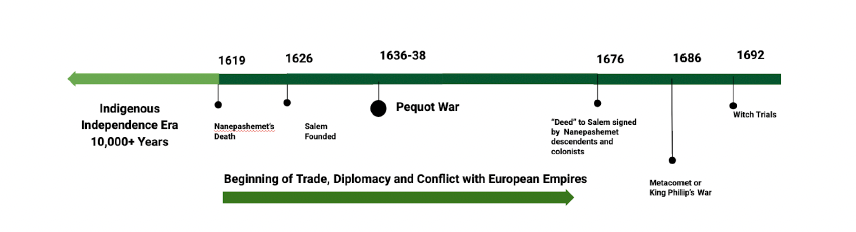
Prelude to War
Tensions between the Pequot and the English colonists intensified in 1634 after Captain John Stone and his crew were killed by Pequots while trading on the Connecticut River after Stone attempted to kidnap a few Niantics. Stone had previously been banished from Boston by the Puritans for drunkenness, adultery, and suspicion of piracy. While the Puritans had no love for Stone, they felt strongly that they could not tolerate the death of any Englishman at the hands of Native people.
Then in 1636, John Oldham—also not a friend to the Puritans—was murdered on Block Island by Niantics allied with the Narragansett. He had been trading with Pequot allies at a time when the Narragansett were trying to claim exclusive trading privileges with the English. (It's worth noting that Oldman was friends with Salem’s founder Roger Conant, but there is no record of Conant participating in the Pequot War.)
When word of John Oldham's death reached Massachusetts, John Endicott immediately mustered a force of approximately 90 men from Salem and Boston to attack Block Island. (It is likely that this force initially mustered on Salem Common nearly a year before the official First Muster).
After a brief skirmish where they killed several Native people from multiple tribes, Endicott proceeded to burn every village on Block Island to the ground and seized their winter stores. Following that attack, Endicott sailed to Saybrook Connecticut to demand the Pequot hand over those responsible for killing John Stone. When the Pequot did not immediately respond, he attacked them, burned several villages to the ground, seized their winter stores, and then returned to Salem.
Following Endicott's attacks, the Pequot began attacking English settlements in Connecticut and Western Massachusetts. The timeframe here must be noted. All of this occurred before the East Regiment first officially mustered on Salem Common in 1637.
It is clear from the timeline of events that it was the English Colonists who were the aggressors in escalating this conflict into a brutal war.
In December of 1636, the Massachusetts General Court called for three regiments to be raised, the first of which mustered at Salem Common in the Spring of 1637, which is the event we celebrate every year on the Common as “The First Muster”.
Mystic Massacre
There were several brutal battles of the Pequot War, but I’d like to highlight one that occurred in Mystic, Connecticut, when English, Mohegan, and Narragansett forces surrounded a Pequot fortified settlement there. The English positioned musketeers at each entrance while the Narragansett and Mohegan shot flaming arrows into the village. As the Pequot tried to flee the flames, the English, under the command of Captain John Mason, shot them dead.
At least 500 Pequot men, women, and children were killed. Mason declared it an act of God who “laughed at his enemies and the enemies of his people to scorn”. He believed he was the tool of God bringing the fires of hell to God’s heathen enemies, stating: “Thus did the Lord judge among the Heathen.” The Narragansett and Mohegan confronted Mason about his slaughter of Pequot and abandoned the English while they murdered everyone in the village. But they were later attacked by a Pequot war party and forced to rejoin the English as they retreated from the site of the atrocity.
Video from the Mashantucket Pequot Museum & Research Center commemorating the anniversary of the Mystic Massacre that occurred on May 26, 1637.
While the East Regiment did not participate in the Mystic Massacre committed by men from Connecticut, they did fight in this war. The Massachusetts Militia did participate in one of the final engagements of the Pequot War known as the Fairfield Swamp Fight, where some of the last survivors of the Pequot were taken as captives.
Genocidal Treaty Of Hartford
In 1630 there were an estimated 16,000 Pequot living in Connecticut. In 1634 smallpox reduced that number to about 3,000 people. By the end of the Pequot war in 1638 only a few hundred Pequot remained. By 1638 the Pequot were broken.
In September 1638, the last of the Pequot signed the Treaty of Hartford.
It is through the Treaty of Hartford that the Pequot War ceases to be merely an atrocity and becomes outright genocide, because it is through this treaty that it became the policy of the Connecticut and Massachusetts Bay Colonies to completely wipe the surviving Pequot from the face of the Earth and completely erase their identity, language, and history.
Under this treaty, all of the surviving Pequots were given as slaves to either the Narragansett or the English. The Pequot were also forbidden from speaking their own language or even ever uttering the word “Pequot” ever again.
This treaty prompted the Colony of Massachusetts to pass a law legalizing slavery and the sale of humans in order to legalize the buying and selling of Pequots (see article 91 of the Massachusetts Body of Liberties of 1641). Thus, Massachusetts became the first state in America to have a law on its books specifically legalizing slavery, which was later found to be in violation of the new Massachusetts constitution after its ratification in 1781.
The Pequot War is, in my opinion, the most shameful moment in Massachusetts history.
The Pequots who became slaves of the Narragansett were able to maintain their identity, and their descendants survive today. Most Pequots who were sold to the English were later sold to sugar plantations in the Caribbean, but a few became household servants and slaves for the New England elite. One enslaved Pequot boy was brought back to Salem as a trophy of war to be given to John Endicott.
Massachusetts National Guard
The East Regiment eventually became the Massachusetts National Guard, and I must note that most of its history is honorable and something to be proud of. They were the first to stand up to the British and set in motion the events that led to our independence. They were never deployed offensively during the War of 1812 due to local anti-war sentiment in Massachusetts during that conflict. They were the first to reply to Southern aggression and defend Washington D.C. from the Confederacy during the Civil War. They liberated tens of thousands of enslaved people from southern plantations, and thousands of Jews, Roma, LGBTQ people, trade unionists, suspected communists, and more from Nazi concentration camps during World War II. They have saved the lives of millions of New Englanders from all manner of natural disasters, and so much more! So much of that history is a history to be proud of, and overall, the Massachusetts National Guard has arguably a far more honorable history than probably any other military unit in the world.
But none of this proud history means that this horrible act of genocide shouldn’t be acknowledged, both by the Massachusetts National Guard and the City of Salem.
In a Facebook post on April 3rd 2026, the City of Salem stated that “the First Muster is one of the oldest chapters in [our] story — proof that Salem has always been a place where neighbors stand up, show up, and serve.” While that is a perfectly fine sentiment, the omission of the Pequot War here is glaring.
Both the Massachusetts Army National Guard’s website and the National Guard's website cite “the growing Pequot threat” as the reason why the militia formed in 1637.
I think the least we can do as a city is acknowledge the actual history of the Pequot War and lasting legacy of genocide and slavery that stems from it.
And for the love of whatever we find sacred, change that line on all National Guard websites! There was never any Pequot threat.
Bio
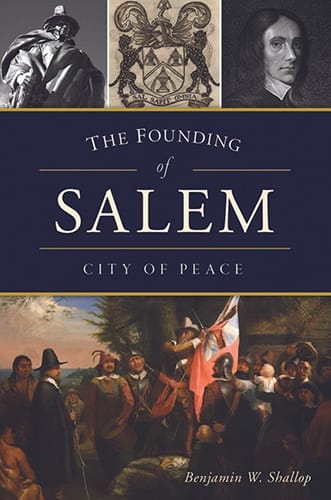
Benjamin Shallop is the author of The Founding of Salem, City of Peace, an account of the early settlement of Salem and the surrounding area in the 1620s. His lifelong love of history began during his childhood in Salem, Massachusetts. He has worked in the Florida Park Service, in education, and as a community and labor organizer. He moved back to Salem in 2008 and works as a union representative in the growing Massachusetts film industry. He is also an active member of several civic organizations in Salem.