
The following historical summary written by David Moffat and Alyssa Rosemartin is reprinted courtesy of The House of the Seven Gables in Salem, MA. This summary was prepared to support an evening of community reflection and conversation with guest speakers from the Mashantucket Pequot Tribal Nation, alongside local author and historian, Benjamin Shallop. The event was hosted at the House of the Seven Gables in March of 2026.
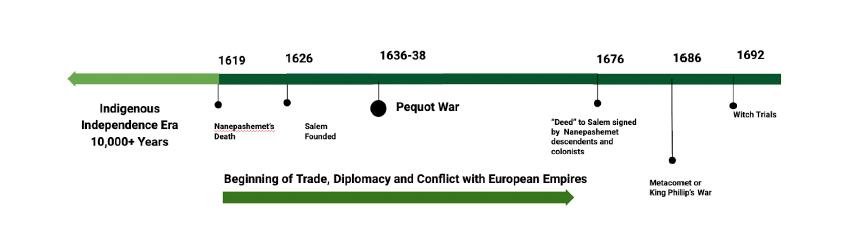
The Pequot War began in July 1636 and ended in September 1638, falling in the middle of a century of trade, diplomacy, and conflict between Indigenous and European Nations.
Indigenous people have lived in the region for at least 12,000 years. By the beginning of the seventeenth-century, the land today claimed by the states of Connecticut, Rhode Island, and New York was inhabited by various groups who spoke Algonquian languages, including the Pequot, Narragansett, Niantic, Nipmuc, Mohawk and Lenape.
Dutch settlers surveyed and claimed the land in the 1610s, and in the 1620s and 1630s English Puritans established several colonies. The trade in furs, particularly beavers, was a major economic driver for political relations. The production of wampum, an important medium of societal status and trade, was upset by new production methods employed by English settlers.
Wampum—beads made of quahog shell. Their time-consuming manufacture made them valuable as signs of status and as trade and diplomatic goods, but they were not used as currency by Indigenous groups.
Wetu—a domed house used by many Indigenous groups in the northeast, which could be lived in by one to four families, depending on size.
The disruption to Indigenous lifeways brought about by European incursion was met with Indigenous resistance and tension between Indigenous groups as they navigated the complicated landscape. Amid this period of rising tension, three killings sparked war: the murder of Pequot sachem Tatobem by the Dutch in 1632, and the deaths of two Englishmen in disputed circumstances: John Stone, in 1634, on the Connecticut River, and John Oldham on Manisses (Block Island) in 1636. The Massachusetts Bay Colony sent John Endicott to retaliate for the latter killings, and he attacked Niantic and Pequot villages, burning wetus and crops and kidnapping children into slavery.
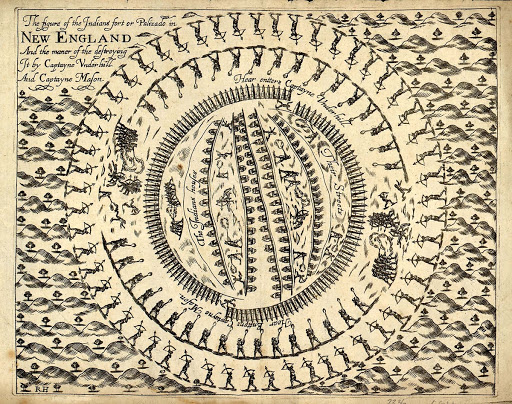
In the face of this English aggression, the Pequot and Western Niantic began besieging Fort Saybrook at the mouth of the Connecticut River, and raiding English villages. The Narragansett and the Mohegan sided with the English, and the Eastern Niantic remained neutral. The English settlers launched a counterattack in May 1637, led by Capt. John Mason and Mohegan sachem Uncas, in which they relieved Fort Saybrook and marched to a Pequot village at the Mystic River.
There on May 26, 1637, the English and their Indigenous allies killed nearly the entire village in an event known as the Mystic Massacre, with estimates of deaths ranging from 400 to 700. Those Pequots who were captured in the war were enslaved, with the implication of sexual violence against girls and women. In July of 1637, the Salem ship Desire brought 15 enslaved Pequot boys and 2 women to the colony of Providence off the coast of Central America and exchanged them for enslaved Africans, who arrived in Boston in February of 1638.
Video from the Mashantucket Pequot Museum & Research Center commemorating the anniversary of the Mystic Massacre that occurred on May 26, 1637.
In the face of genocidal attacks, the Pequot sachem Sassacus and his troops sought asylum with the Mohawk who were allied with the Dutch, where he was betrayed and killed. The war ended with Sassacus’ death, and those Pequot who survived were forced to integrate with the Narragansett and Mohegans. The Dutch and Mohawk launched a war against Indigenous groups within the territories they claimed (including the Mohican, Lenape, and Wappinger) in 1643, killing at least 1,600 Indigenous people before the war’s end in 1645.
 NSP Staff Writer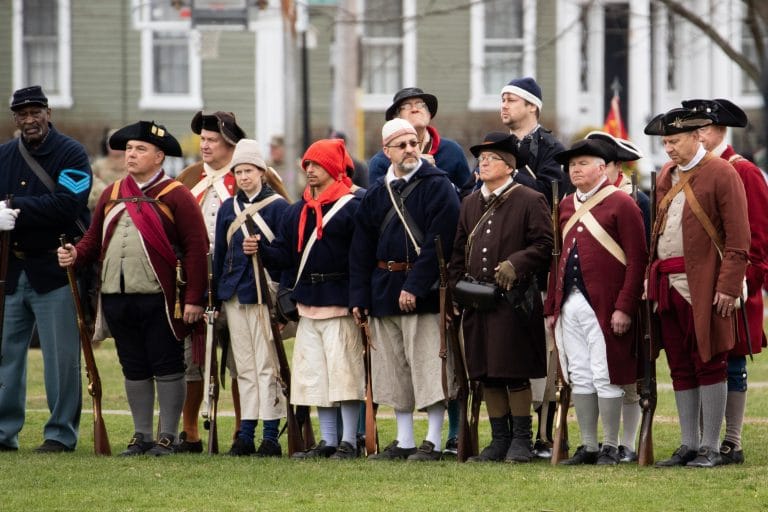
To the east, an uneasy peace lasted for 37 years as the English continued to expand their settlements, eventually capturing New Netherland in the 1660s. In 1675, the Wampanoag sachem Metacomet, attempting to repel the expanding English settlements, created an alliance of Indigenous groups including the Narragansett, Nipmuc, and Wabanaki confederacy, sparking what the English called King Philip’s War, in which the Pequot, Mohegans, and Mohawks allied with the English. After three years of violent war, the New England colonies defeated Metacomet and his allies, solidifying their presence in the region. Indigenous people, particularly the Wabanaki Confederacy, continued to fight English hegemony through a series of wars from the 1690s to the 1740s.
Recommended Actions
The authors recommend visiting the Mashantucket Pequot Museum and Research Center in person to learn directly from Tribal members about their history and culture. If you are unable to travel to Mashantucket, CT, here is a virtual tour of the museum:
Virtual tour of the Mashantucket Pequot Museum & Research Center in Mashantucket, CT.
Please also consider donating to the museum and research center to support their work.

Additional Educational Resources

Bios
David Moffat is a writer, poet, and antiquarian from Hamilton, Massachusetts. He currently serves as the Researcher at The House of the Seven Gables featuring three seventeenth-century houses and the birthplace of Nathaniel Hawthorne. Beginning his museum career in the fall of 2012, David has designed six exhibits, developed comprehensive interpreter training, and implemented new site-wide interpretation. In his personal time, David enjoys drawing, traveling, and watching classic movies.
Alyssa Rosemartin is a writer, ecologist and community builder of European descent. She has published scientific work in the fields of ecology, climate change, data management and the co-production of knowledge. Her short fiction has been nominated for a Pushcart Prize. Alyssa has worked closely with Indigenous communities for over a decade. She works to collaboratively understand and heal historic harms, create life-giving space and foster radical imagination.


